Reverse-charge VAT in the Netherlands: when and how it works
Updated 24 November 2026 · 6 min read
Written and checked by Pondo. How we write
In this articleWhat does 'btw verlegd' mean?
With reverse-charge VAT (btw verlegd), your client pays the VAT instead of you. You charge no VAT and put 'btw verlegd' and your client's VAT number on the invoice. It applies to subcontracting in construction and to services for businesses in other EU countries, among others.
Do you subcontract in construction, or have business clients in other EU countries? Then you'll come across the Dutch reverse-charge scheme (verleggingsregeling). Your invoice looks different, and you use a different box on your VAT return.
What does 'btw verlegd' mean?
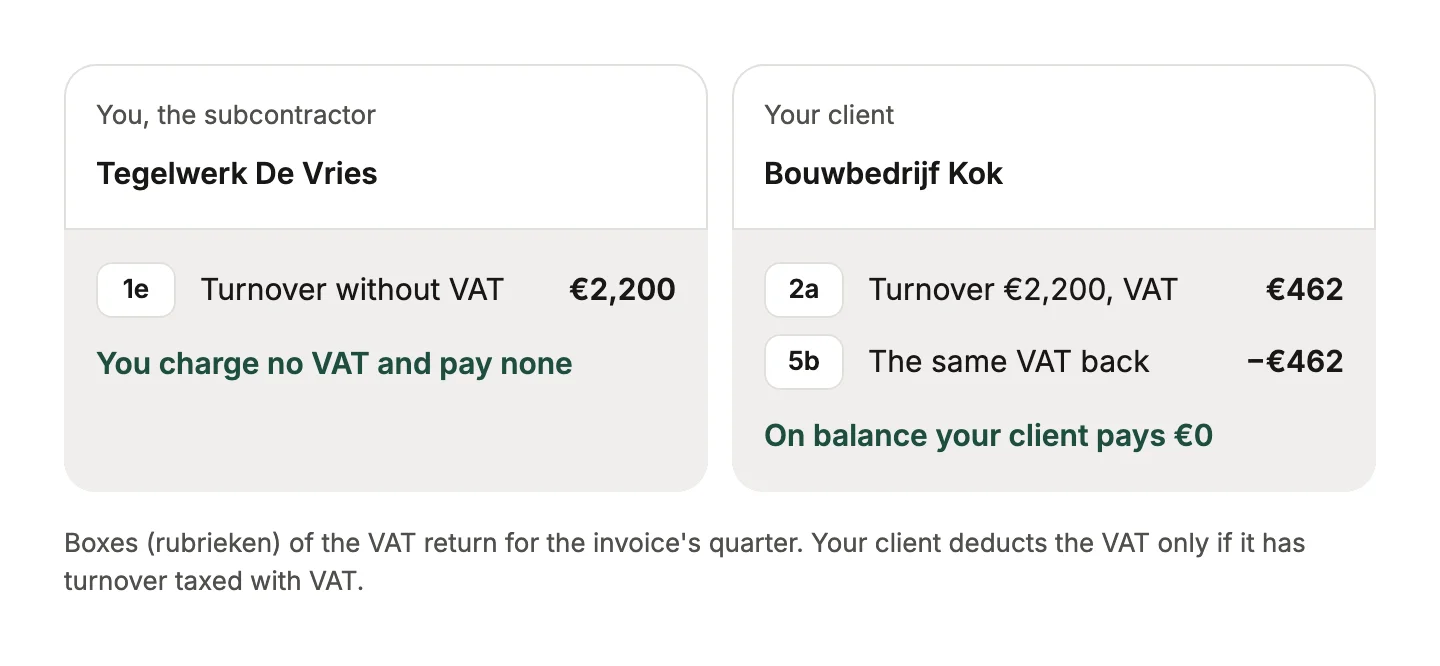
'Btw verlegd' means your client declares and pays the VAT, not you. So you charge no VAT. Your client works out the VAT and deducts it in the same return, if its own sales are subject to VAT. So in the end it pays nothing.
You do stay responsible. If you reverse-charge when you weren't allowed to, the Belastingdienst can claim the VAT from you. So check before you invoice.
When do you reverse-charge VAT?
The Belastingdienst lists these cases:
| Situation | When exactly |
|---|---|
| Subcontracting and hiring out staff | Physical work on property or ships in construction, shipbuilding, cleaning and landscaping |
| Services to a business in another EU country | Usually: the service is taxed in your client's country |
| Mobile phones, chips, game consoles, laptops and tablets | At €10,000 or more excluding VAT, per type of goods, per delivery |
| Waste and scrap | Such as metal scrap, and paper and glass for reuse |
| Property | When you and the buyer opt for a sale with VAT |
| Other | Gold, forced sales, emission allowances, gas and electricity certificates, telecom services between telecom companies |
In construction it covers work such as building, demolition, maintenance, repairs and cleaning. An architect's design work doesn't count. Neither does work you do mostly (over half) in your own workshop.
For phones, chips and laptops the limit applies per type of goods. Splitting an order over several invoices doesn't help: you then reverse-charge on the whole order.
The rule for phones, chips, laptops, emission allowances, certificates and telecom rests on an EU rule that ends on 31 December 2026. On 1 October 2026 the European Commission proposed extending it to 30 June 2030. That isn't final yet. Construction, waste, property and gold aren't affected.
What goes on the invoice?
With reverse-charged VAT, your invoice shows:
- no VAT, but the words 'btw verlegd';
- your client's VAT number, next to your own;
- the amount excluding VAT, per VAT rate that would apply without the reverse charge.
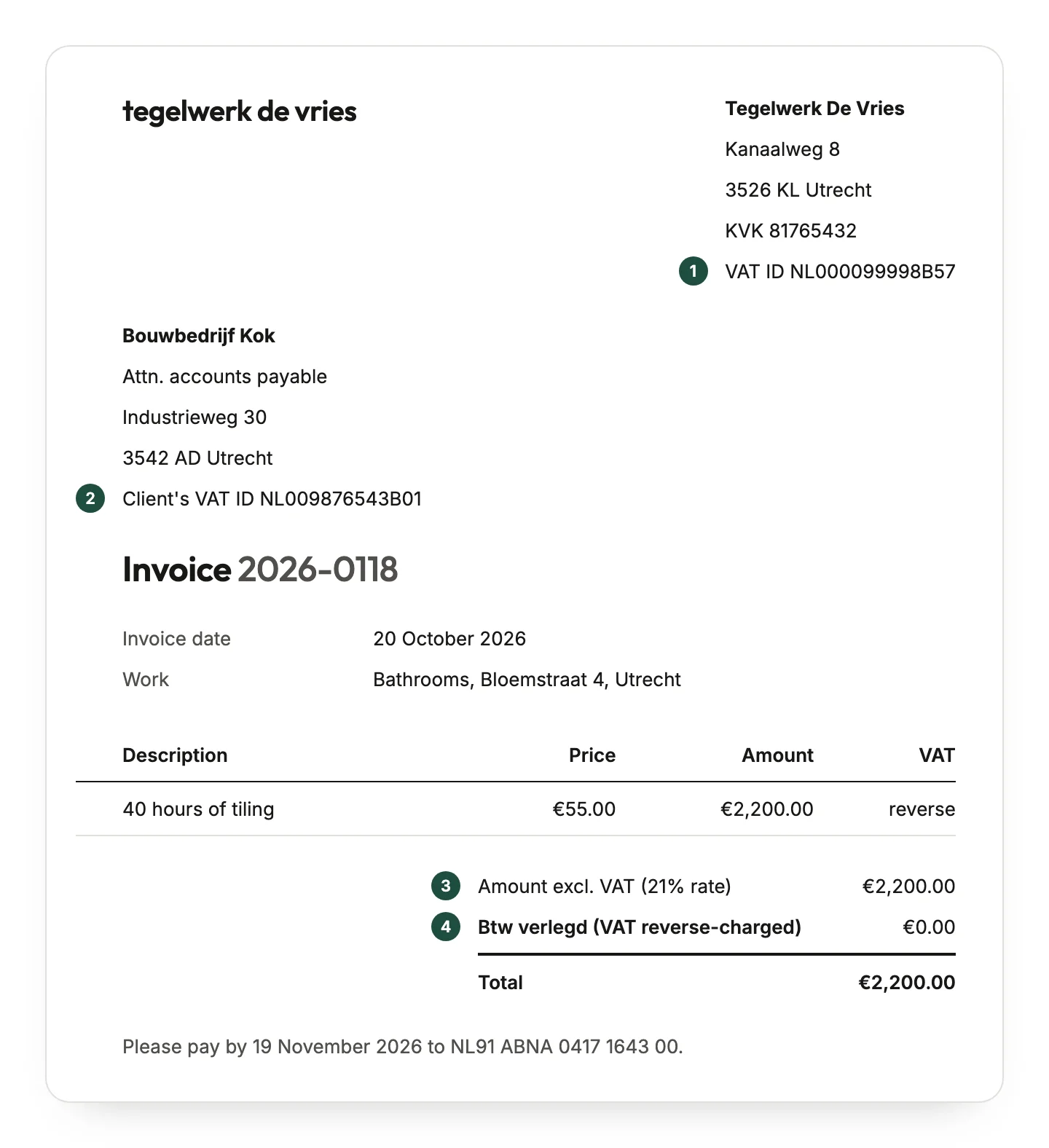
All the usual Dutch invoice requirements apply too. You don't need a reference to the law or your client's KVK number on it, whatever some sites say.
For a client in another EU country you may write the words in English, German or French, such as 'reverse charge'. Such an invoice must always be a full invoice.
Which VAT return box do you use?
| Who | Situation | Box (rubriek) |
|---|---|---|
| You | VAT reverse-charged to a client in the Netherlands | 1e: the turnover |
| You | Services or goods to a business in another EU country | 3b: the turnover |
| You | Services to a business outside the EU | Not on your return |
| Your client | VAT reverse-charged to it in the Netherlands | 2a: turnover and VAT, and 5b: the VAT deducted |
| Your client | Purchases from abroad | 4a (outside the EU) or 4b (inside the EU), and 5b |
A service to a business in another EU country goes in the period in which you supplied it. The invoice date doesn't matter for this. Read more about boxes 1e and 3b of your Dutch VAT return.
What about a client outside the EU?
Is the service taxed in your client's country outside the EU? Then you charge no Dutch VAT and leave the service off your VAT return. Dutch rules don't require 'btw verlegd' on that invoice. Your client's country may have its own requirements.
What is the EC sales list (opgaaf ICP)?
The EC sales list (opgaaf intracommunautaire prestaties, ICP) lists your clients in other EU countries, with their VAT number and the amount. You file it alongside your VAT return, for every period with such a service or supply.
- For services you may file per month, per quarter or, with permission, per year.
- It must reach the Belastingdienst within 1 month of the end of the period. For the fourth quarter of 2026 that's Monday 1 February 2027, because 31 January is a Sunday.
- Its total must match box 3b for the same period.
The Belastingdienst's English page says 2 months. That deadline is for businesses not established in the Netherlands.
How do you check a client's VAT number?
You check a VAT number in VIES, the European Commission's lookup. If the number is invalid, or the name and address don't match, contact your client. As long as the VAT number isn't valid, you charge Dutch VAT.
Keep the result of your check. If it later turns out the reverse charge didn't apply, you can face an additional assessment and a penalty.
What if you charged VAT after all?
Did you charge VAT where you should have reverse-charged it? Then you still have to pay that VAT, and your client can't deduct it. Send a credit note for the wrong invoice and a new invoice marked 'btw verlegd'.
And if you use the KOR?
On the small business scheme (KOR)? Then you charge no VAT and reverse-charge nothing. Turnover that would be reverse-charged to a Dutch client does count towards the €20,000 limit.
Do you receive an invoice with reverse-charged VAT yourself? Then you must file a VAT return for that VAT even under the KOR, and you can't deduct it. This is called a one-off return (incidentele aangifte).
How it works in Pondo
Add a reverse-charge VAT rate, such as 'Btw verlegd binnenland' or 'Dienst binnen EU (btw verlegd)'. You can do that from the invoice itself. Then choose it on an invoice line. Pondo puts 'VAT reverse-charged' (or 'btw verlegd' on a Dutch invoice) and your client's VAT number on the invoice, and checks that number in VIES. On your VAT return the turnover goes into box 1e or 3b automatically. Read more about invoicing in Pondo.
Frequently asked questions
Is reverse-charged VAT the same as 0% VAT?
No. The 0% rate applies to exports and to goods sent to businesses in other EU countries, for example. With a reverse charge, your client pays the VAT. In both cases you can still deduct the VAT on your own costs.
As a freelancer in construction, do I always reverse-charge?
Only when you do physical work as a subcontractor for another business. If you work directly for a private person, you charge VAT as normal.
Sources
- VAT on services abroad, business.gov.nl
- Reverse-charging VAT, Belastingdienst
- When to reverse-charge VAT, Belastingdienst (Dutch)
- Invoicing with the reverse-charge scheme, Belastingdienst (Dutch)
- Services to clients outside the EU, Belastingdienst (Dutch)
- EC sales list (opgaaf ICP), Belastingdienst (Dutch)
- Checking VAT numbers, Belastingdienst (Dutch)
- Proposal to extend article 199a (ST 13970/26), Council of the EU