Credit notes in the Netherlands: how to correct an invoice
Updated 24 November 2026 · 7 min read
Written and checked by Pondo. How we write
In this articleWhat is a credit note?
You don't edit an invoice you've sent. You issue a credit note (creditfactuur): a new invoice with its own number that refers to the original and says what changes. You lower the VAT in the return for the quarter in which the discount, returned goods or cancellation was settled.
Has a client sent something back, have you given a discount since, or is there a mistake on your invoice? Then you issue a credit note. That keeps your books, and your client's, correct.
What is a credit note?
A credit note reverses an earlier invoice, in full or in part. In Dutch it's a creditfactuur or creditnota; both mean the same thing, and the law uses neither word.
Under Dutch VAT law, any document that changes an invoice and clearly refers to it counts as an invoice itself. That's article 34f of the Dutch VAT Act (Wet op de omzetbelasting 1968). If you need to charge more instead, you send an additional invoice (aanvullende factuur).
Can you edit or delete an invoice you've sent?
No. You keep an invoice in the form you sent it, and your invoice numbers run in sequence without gaps. So you fix a mistake with a new document that refers to the old invoice.
As long as an invoice is still a draft and hasn't been sent, you can simply change it. No credit note is needed for that.
When do you issue a credit note?
| What happens | What you do |
|---|---|
| Your client returns part of an order | Credit the returned part |
| You give a discount afterwards | Credit the discount |
| The job is cancelled | Credit the whole invoice |
| Wrong client, date or VAT rate | Credit the whole invoice and send a new one |
| VAT charged where it should have been reverse-charged | Credit the whole invoice and send a new one marked 'btw verlegd' |
| Your client doesn't pay | No credit note needed, see below |
What must a Dutch credit note show?
A credit note may be a simplified invoice (vereenvoudigde factuur). Many sites say it must meet every invoice requirement, but that isn't so. This is what you put on it:
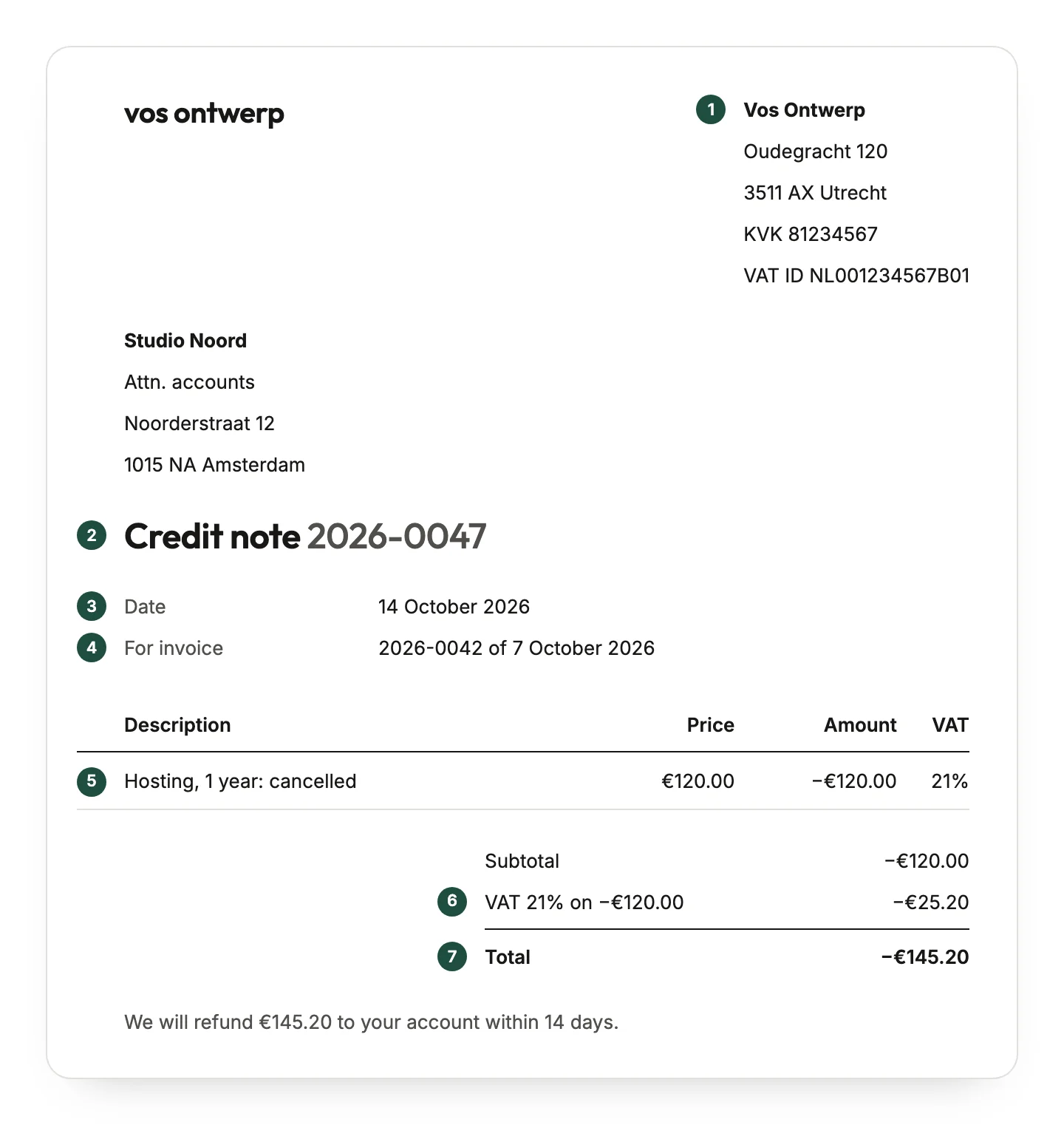
- Your name and address.
- A number of its own. The law doesn't require one on a simplified invoice, but it keeps your records complete. The words 'credit note' aren't required, but they make it clear to your client.
- The date you issue it.
- A reference to the original invoice, with its number and date.
- What changes, with the amount. The law requires this, even though the Belastingdienst's page leaves it out.
- The VAT, at the same rate as on the original invoice.
- The total you refund or set off.
Do you supply goods to a business in another EU country, or make distance sales to consumers there? Or do you reverse-charge VAT to a client in another EU country? Then the credit note must be a full invoice that meets all the Dutch invoice requirements.
Crediting only part of an invoice? Then the original invoice and the credit note count as one invoice, and between them they must show every required detail.
What number does a credit note get?
Give a credit note a new number of its own from your sequence. You may also use a separate series, such as CR-2026-001. Each number is used only once, so you never reuse the original invoice's number.
Where does a credit note go on your Dutch VAT return?
A credit note goes in the VAT return (btw-aangifte) for the period in which the discount, returned goods or cancellation was settled. Usually that's the quarter in which you issue the credit note. You don't correct your old return.
Did you charge VAT you didn't owe, such as a wrong rate or VAT you should have reverse-charged? You still owe that VAT. You only get it back by asking the Belastingdienst for a reduction, unless the wrong invoice and the credit note fall in the same period.
You enter the turnover and VAT as negative amounts, in the same box (rubriek) as the original invoice:
| Original invoice | Box | What you enter |
|---|---|---|
| 21% VAT | 1a | Negative turnover and negative VAT |
| 9% VAT | 1b | Negative turnover and negative VAT |
| VAT reverse-charged to a Dutch client | 1e | Negative turnover |
| Service to a business elsewhere in the EU | 3b | Negative turnover, and in your EC sales list (opgaaf ICP) too |
An example: your September invoice of €1,210 including 21% VAT gets a credit note of €121 in October. In your return for the fourth quarter you enter −€100 turnover and −€21 VAT in box 1a. Your client, in turn, can deduct €21 less in VAT.
A mistake in a return you've already filed is corrected differently. Read how to correct a Dutch VAT return.
How do you issue a credit note under the KOR or with reverse-charged VAT?
On the small business scheme (KOR)? Then a credit note shows no VAT either. You don't file VAT returns, so there's nothing to process.
Did the original invoice say 'btw verlegd'? Then the credit note follows it: no VAT, 'btw verlegd' and your client's VAT number. Read more about reverse-charge VAT.
Your client doesn't pay: do you issue a credit note?
No. If your client doesn't pay, you reclaim the VAT as soon as it's certain you won't be paid. The invoice counts as uncollectible one year after the agreed due date at the latest. You then enter the turnover and VAT as negative amounts in your return, without a credit note.
If your client pays after all, you owe that VAT again. This rule doesn't apply if you use cash accounting (kasstelsel).
How it works in Pondo
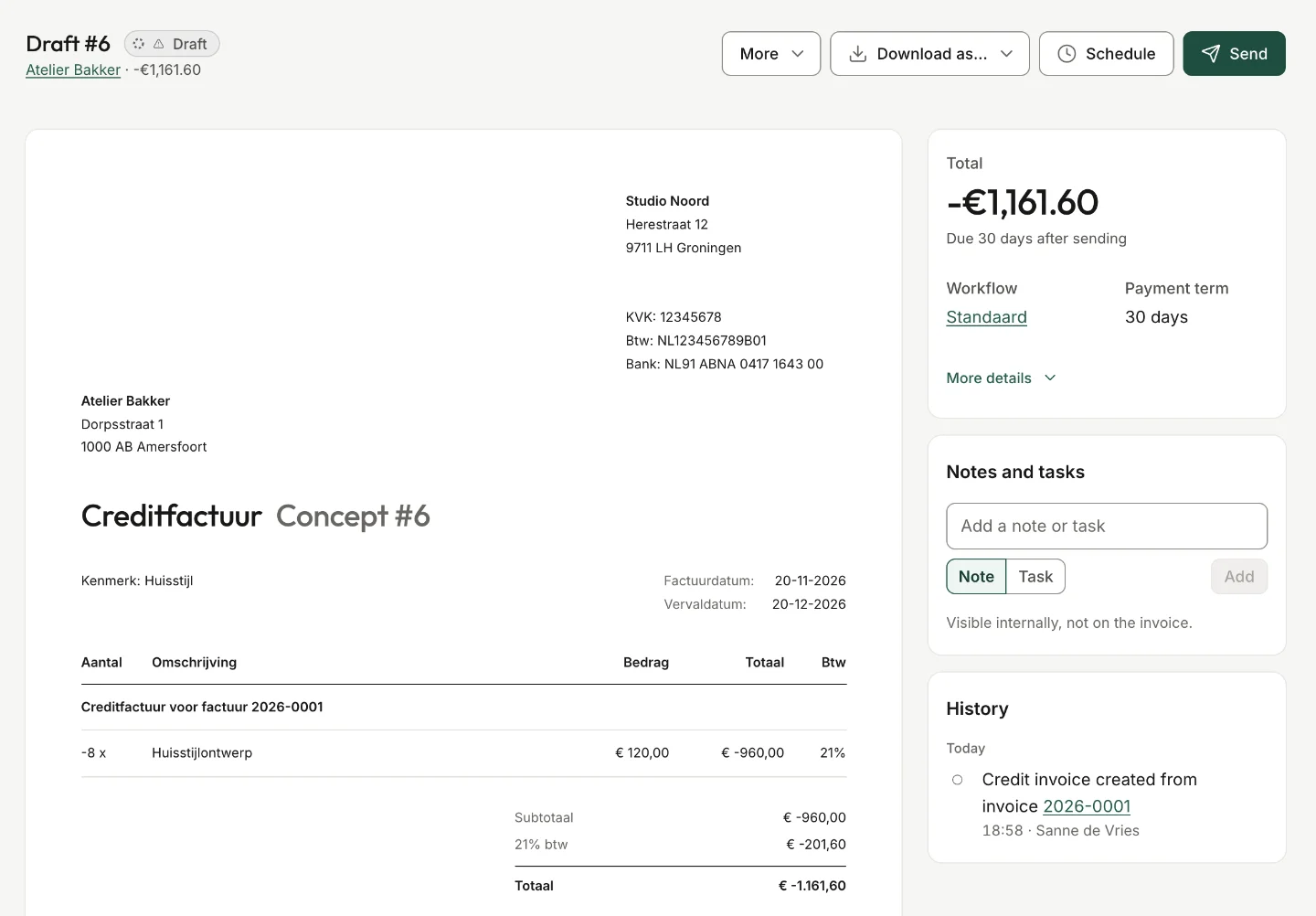
Open the invoice and choose 'Duplicate as credit invoice' under More. Pondo creates a draft credit invoice, its name for a credit note. It has the same lines as negative amounts and a reference to the original invoice. Remove what doesn't change and send it; it then gets its own number.
Read more about invoicing in Pondo.
Frequently asked questions
Do the amounts on a credit note have to be negative?
On your VAT return, yes. The law doesn't prescribe a minus sign on the document, but negative amounts are usual and clear. With an e-invoice, the document type is what marks it as a credit note.
Can my client issue a credit note themselves?
Not in their own name. The Belastingdienst says it's not correct for a client to draw up a credit note in their own name.
How long do I keep a credit note?
Like other invoices, for 7 years. Invoices relating to property are kept for 10 years.
Sources
- Invoice requirements, business.gov.nl
- Wet op de omzetbelasting 1968, articles 29, 34d, 34f and 35a, wetten.overheid.nl (Dutch)
- Invoicing decree, 1 May 2025, Staatscourant (Dutch)
- Simplified invoice, Belastingdienst (Dutch)
- VAT back after a price reduction or cancellation, Belastingdienst (Dutch)
- VAT back on uncollectible debts, Belastingdienst (Dutch)
- Invoices issued by the client, Belastingdienst (Dutch)
- Keeping your invoices, Belastingdienst (Dutch)